
WELCOME LETTER
- 9.15.06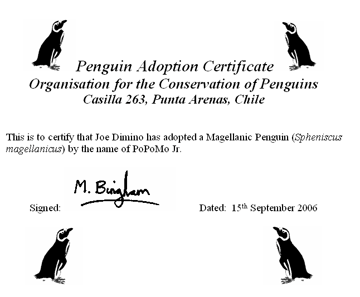
You have been enrolled under our penguin adoption programme by Judy Shute Spred,
and your penguin has been given the name PoPoMo Jr.
Your adopted penguin is an adult Magellanic penguin, a species which is only found around southern South America. Each year we monitor population changes at selected breeding sites in Chile, Argentina and the Falklands, and money raised through our penguin adoption programme helps to pay for this work.
At the beginning of each breeding season we visit our selected study sites and examine each and every burrow to see how many breeding pairs are in the colony. This allows us to record any population changes, since Magellanic penguins return to the same colony to breed each year. This work has revealed an 85% population decline over the last 12 years in the Falkland Islands, whilst populations in nearby Chile and Argentina have increased.
As well as population counts, we also monitor all our adopted penguins throughout the season, in order to see how many eggs hatch, and how many chicks survive. By monitoring penguins over a number of years we are able to spot differences in breeding success, and find the causes of population decline.
These studies have shown that in the Falkland Islands, breeding success is much lower than in nearby Chile and Argentina, due to chick starvation in the Falklands. Chick survival in the Falklands is less than half that of Chile and Argentina because commercial fishing around the Falklands makes it hard for penguins to find food for their chicks.
In Chile and Argentina, where commercial fishing
is banned close to penguin colonies, chicks are fed every 12 to 14 hours. In the
Falklands, where there is no such protection from commercial fishing, chicks are
fed every 34 hours. The lower abundance of food resulting from commercial
fishing means that adult penguins must spend over twice as long finding food to
feed their chicks in the Falklands. As a result, chicks in the Falklands receive
less than half the amount of food, so few
chicks survive, leading to
population decline.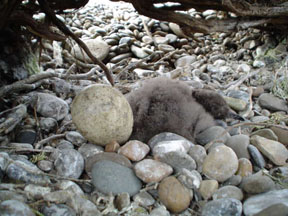
In September 2000, members of the International Penguin Conservation Work Group passed a resolution calling for no-fishing zones around penguin breeding sites in the Falkland Islands, as has been done in Chile and Argentina. Unfortunately the Falkland Islands Government have refused to honour this, despite the decline in penguin numbers.
Another potential threat to penguins is tourism, however our studies into the effects of tourism show no differences in breeding success for sites visited by tourists and those which are not. This is good news for anyone thinking of visiting their penguin. They can be confident that their visit will not cause disturbance, and that we are monitoring the affects of tourism on penguins.
Our adoption programme runs for one year, although of course it can be renewed each year to follow the same penguin. Magellanic penguins arrive at the breeding sites in September, which is when we begin our monitoring work.
Eggs are laid during October, and chicks hatch during December. Chicks leave in February, but adults that have reared young remain around the breeding site until April.
Between April and September, Magellanic penguins remain entirely at sea, migrating northwards up the coast of Argentina, Uruguay and Brazil, where the austral winter offers longer hours of daylight and warmer waters.
I attach a few photographs of our study colony birds, because your actual penguin needs to be selected, and its burrow marked with its name, before we can send you photos of your own penguin. As soon as this happens, you will be sent photographs of your adopted penguin, its nest, and a map showing the location of its burrow in case you wish to visit.
Throughout the breeding season you will be kept
updated as to how your penguin is doing - when the eggs are laid, when they
hatch, and how the chicks fare. We will also send you photos of any chicks.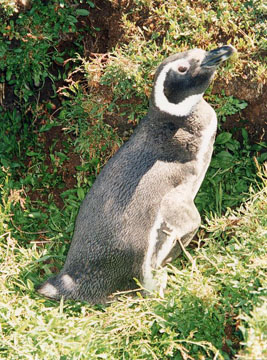
I would like to take this opportunity to address an increasing problem with sending email. Spam has become an increasing problem each year, but worst still is the recent boom in spam filters, none of which are totally reliable, causing genuine email to be deleted.
We would also like to remind you of our promise that we NEVER pass on email addresses to anybody else, and never use them for any other purpose than for sending out penguin reports. You can therefore be confident that the email addresses you register with us will not generate spam.
Thank you once again for supporting our vital work. It is only by studying penguin populations that the causes of penguin decline can be discovered and stopped. You can find detailed reports of our work on the following web sites www.falklands.net www.penguins.cl www.seabirds.org
Best wishes,
Dr Mike Bingham
Environmental Research Unit
LETTER 1 -
 9.27.06
I have pleasure in attaching a map of your penguin's colony, which is situated
on Magdalena Island, about 35 kilometres north east of the city of Punta Arenas
in southern Chile. You should be able to find this on any good world atlas or
map of Chile. You can also find it on our web site at
www.seabirds.org/magdalena.htm.
More information about the
Magdalena Island colony can be found on our web site at
www.seabirds.org/study-chile.htm
Magdalena Island lies in the Straits of Magellan, which is of considerable historical importance, since it links the Atlantic and Pacific Oceans, making it possible for ships to avoid travelling around the notorious Cape Horn. This important short-cut from the Atlantic to the Pacific was discovered by the Portuguese sailor Hernan Magallanes in 1520, hence the name Straits of Magellan.
The entire length of the Straits of Magellan is marked by lighthouses, most of which were built in the late 1800s to help guide ships safely through the Straits.
Magdalena Island itself has just such a lighthouse, which is still in operation to this day, and which is open to tourists. Two wardens live on the island all year round, protecting the penguins and keeping the lighthouse in order.
The entire Straits of Magellan are closed to commercial fishing vessels by a no-fishing zone. This allows the penguins of Magdalena Island to maintain a reliable food supply, which is the main reason for their high breeding success.
The Magdalena Island penguin colony is currently healthy and gradually increasing in size, thanks to the no-fishing zone, good management of tourism, and our constant monitoring, which in turn is thanks to your support of our penguin adoption programme.
The penguin population on Magdalena Island has increased from 60,000 pairs to 70,000 pairs since our adoption programme began in 1999.
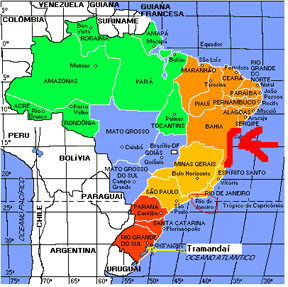
Our adopted penguins have finished their moult and have all left the colony, somewhat later than usual. They are now gradually making their way up the Atlantic coast of Argentina and Uruguay. Many of them will eventually reach Brazil. I attach a map showing the area where our penguins were reported as being sighted a couple of years ago. You will see that it is well north of Rio de Janeiro, a very long journey indeed.
Even when they are not migrating, penguins swim long distances each day, swimming around looking for fish to eat. During their migration they do not really swim any further each day, but simply hunt fish in a straight line heading north, so that over the next few weeks they gradually end up further north. They have no particular destination. Some penguins will stop in Uruguay, and some will reach as far as the area marked on the attached map.
During this time the penguins keep a few kilometres away from the coast, and never come out of the water. They eat and sleep in the water. Penguins only leave the water to raise chicks and to carry out their annual moult. So many people living in Uruguay and Brazil do not even realise how many penguins are passing by their beaches each year.
Penguins are well adapted to cold conditions, so they do not move northwards during winter to find warmer weather. During the winter the days are shorter nearer the poles, so by moving northwards in winter they find longer hours of daylight, daylight which they need in order to see the fish they hunt 20 metres below the water.
The last of the oiled penguins are also being released, having been cleaned and given 4 weeks for their feathers' natural oils to come back. Dirty oil is damaging to the penguins, but penguins do need their feathers to be coated with a natural oil that makes their feathers water-proof. Cleaning the dirty oil off the penguins removes this natural oils too, so the penguins are kept in large cages until these natural oils return, which takes about 4 weeks.
The source of the oil spill was never discovered, but because it affected penguins from Cabo Virgenes in Argentina to Magdalena Island in Chile, a distance of around 150 kilometres, it seems likely the oil came from a tanker or cargo ship that was trailing oil as it navigated through the Straits of Magellan. The source will probably never be found.
In a few weeks time our penguins will reach the furthest point of their migration, and will begin their gradual journey back home, arriving back in the colony sometime in September. During the winter migration we are unable to trace the progress of each penguin, and can only await their return like expecting parents.
Tracking devices have been used to track the movements of individual penguins during the winter migration, and our knowledge of their winter migrations is based on this research, and on reported sightings from people in Uruguay and Brazil (mostly from fisherman or occasional reports of oiled penguins).
But using tracking devices is not possible, or even desirable, for large numbers of penguins. The devices are expensive at around $2,000 each, and they are large because of the need for a battery that transmits for 6 months.
Putting a tracking device on a penguin is like strapping a 50 kilo backpack on a person as they set off on a long hike. Not only is it a heavy burden to carry, but it also reduces the distance and speed they can travel, giving readings for speed and distance travelled that are altered. For this reason few penguins our tracked, and readings obtained can only give a general idea of migration patterns.
Once the penguins are back in the colony to breed, your penguin's nest will be marked with the name you choose, and you will receive photos of your actual penguin.
You should receive the first of these photos during the first week of November approximately. You will then receive updates every 6 to 8 weeks, most with photos or other attachments of interest.
In the meantime, you might be interested to hear that our penguin adoption programme recently appeared on German TV. You can see a summary at http://www3.ndr.de/ndrtv_pages_std/0,3147,OID2251842_REF2434,00.html
LETTER 2 - 10.7.06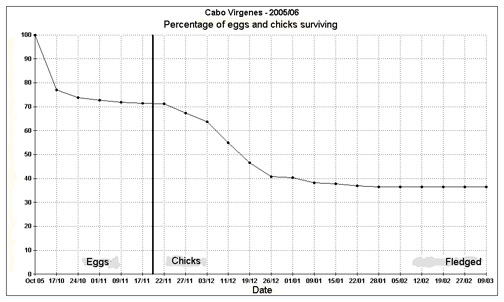
Our adopted penguins have reached the furthest point of their winter migration
and are on their journey back home. Their late depart this year means that they
are unlikely
to have got any further than northern Uruguay or southern Brazil. They will
arrive back in the colony in a few days, and will begin nest building.
Partners do not stay together during the winter migration, so they must meet up again back at the colony. Males usually arrive back at the colony a few days before the females, and wait around for their partners to return, to ensure that their partners do not have the opportunity to pair up with other males.
There are always more male penguins than females, so if a male looses his partner it can be difficult for him to find a replacement partner. By contrast if a female looses her partner, she has many single males from which to choose.
As a result, if the female arrives at the nest site first, and cannot find her previous mate, she will quickly pair up with another unattached male nearby.
This makes sense, since if she delays breeding too long for a mate that may never arrive, she is likely to loose her opportunity to breed for that season. It is therefore essential that the male arrives at the nest site before the female, if he wishes to avoid the risk of losing his previous year's partner.
On occasions a female may arrive at the nest site first, and not finding her previous mate, will proceed to pair up with another male, only to reform her partnership with the previous year's partner when he finally shows up. This leaves her unsuspecting partner incubating and rearing the offspring of another male.
This is an added incentive for male penguins to arrive at the nest site in good time.
Whilst our adopted penguins are still at sea we do not have any information on each individual penguin, but this is perhaps a good time to share with you the results of last season's research. I attach two graphs showing the breeding success of our colonies at Cabo Virgenes in Argentina, and Magdalena Island in Chile.
At the start of each graph, marked "Oct 05" for October 2005, every nest has two eggs which have just been laid, so the percentage of eggs surviving is 100% (none of the eggs have been lost yet). The line along the bottom marked "Date" shows the date written as day/month (eg. 17/11 is 17th November 2005). As time progress, gradually eggs are lost or fail to hatch for a variety of reasons, so the percentage surviving gradually reduces.
The vertical line between "Eggs" and "Chicks" shows the average hatching date for the colony. The small chicks are particularly vulnerable and some always die shortly after hatching. They can easily die from being stood on by the adult, or getting cold or wet if it rains, or from many other reasons, so the percentage surviving continues to fall after hatching, and this is totally normal. However after the chicks reach about 2 weeks of age they are much more resistant, and their survival is then dependent mostly on food availability.
If food is abundant, then the "percentage surviving" line on the graph usually stops dropping about three or four weeks after the hatching date.
Most chicks that survive the first two weeks of life will go on to become fledglings, which is when they leave the colony to begin life on their own.
The graph for Cabo Virgenes (Argentina) shows this pattern clearly, except that eggs loses were higher than normal in early October, due to the oil spill we had at that time, which caused some penguins to abandon their nests. Also chick loses were higher than normal during December as a result of heavy rains that caused many chicks to die from exposure.
Overall 37% of the eggs originally laid in October resulted in a chick that fledged to begin life on its own. Since each nest has two eggs, that means an average of 0.74 chicks fledged per nest. This is not bad, but is lower than normal for the reasons explained in the paragraph above. About 1 chick per nest would be more usual for Cabo Virgenes.
The graph for Magdalena Island (Chile) follows the usual pattern until the second week of January (06/01 to 13/01) when a week of exceptionally bad weather caused chicks to die from exposure at an age when they would usually be safe. The season finished with about 50% of the eggs resulting in a fledgling, which with two eggs per nest equals 1 fledgling per nest. This again is lower than the average for Magdalena Island, which usually averages 1.3 chicks per nest, but nevertheless 1 chick per nest is sufficient to maintain a healthy population.
I hope the above information is not too confusing. To sum up, both our study sites in Chile and Argentina were slightly below average in terms of chicks successfully reared last season, but not enough to be of concern. In the case of Chile, this was entirely the result of bad weather. In our Argentine study site it was a combination of an oil spill, followed later by bad weather.
However both these colonies are healthy, and have expanded in number over recent years, so last year's reduction in breeding success is not a worry.
Even the most successful colonies have variations in success year by year.
They can't all be good years.
Oil spills are the only real threat to these colonies, and the Straits of Magellan is a major shipping route connecting the Atlantic with the Pacific, avoiding the dreaded Cape Horn. This year two separate oil spills at Cabo Virgenes caused some nests to be abandoned early in the season, and a few adult penguins to be oiled. The numbers affected were small, and most oiled penguins were rescued and cleaned. We were also lucky that when the second spill occurred, which was a much larger spill, most of the penguins had either left on their winter migration, or were on land undergoing their winter moult, where they were safe.
This time we were lucky. A major spill during January could do a lot of harm, and yet the laws of the sea do not permit the governments of Chile or Argentina to control the movement of vessels of other nations through the Straits of Magellan, so there is no easy solution to this threat.
Hopefully this year we will have no more spills, and better weather during chick rearing. I will write to you again when the penguins have laid their eggs.
LETTER 3 - 10.22.2006
I am just writing to let you know that all our adopted penguins are now back in
the colony safe and sound. Our penguins in our study site in Argentina finished
egg-laying a couple of weeks ago, and their photos have gone out, but the
penguins at Magdalena Island in Chile are later than usual egg-laying this year.
PoPoMo Jr and friends are back in the colony, and rebuilding their burrow which
suffered badly from heavy winter rains. But it will be about another two or
three weeks before we have the photos of PoPoMo Jr for you. Last season the
penguins left later than usual on their winter migration, so it is not unusual
for them to return later as well.
Sorry for the delay. I will write to you as soon as egg-laying is completed and
we have taken the photos.
11.17.06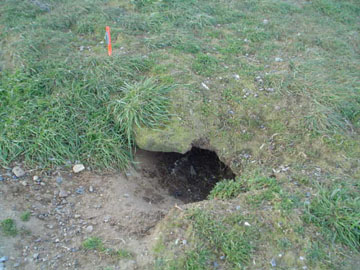
Our adopted penguins have now returned to the colony, and have spent the last couple of weeks repairing their nests and laying eggs. Your penguin's nest now has two eggs, which is the usual number for Magellanic penguins. I am pleased to be able to attach a photo of your penguin sitting over the eggs.
Your penguin lives in the penguin colony on Magdalena Island, which is about 45 kilometres north-east of the city of Punta Arenas in southern Chile. It is situated in the middle of the Straits of Magellan, between mainland South America and Tierra del Fuego.
You should be able to find Punta Arenas and the Straits of Magellan on any good world atlas. You can also see the colony marked on our web site map at
www.seabirds.org/penguinstudysites.htm . If you click the link on this interactive map, you will see more information and photos about the colony.I also attach a map of the colony, to show you exactly where your penguin's nest is located, in case you ever want to visit.
Each egg is about twice the size of a chicken egg,
weighing 125 grams each, and they take about 40 days to hatch. Both adults take
turns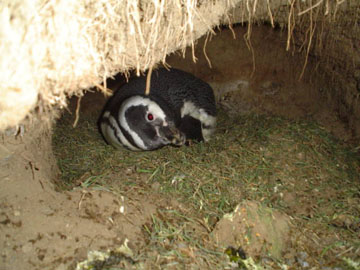 incubating the eggs during this time. Whilst incubating the eggs the adults
cannot feed, so by changing over every few days, both adults are able to go to
sea to feed.
incubating the eggs during this time. Whilst incubating the eggs the adults
cannot feed, so by changing over every few days, both adults are able to go to
sea to feed.
Incubating the eggs not only keeps them warm, but also protects them from gulls and skuas, that would steal the eggs given the chance. The nests are in burrows, which offer some protection from normal rain, but if very heavy rain falls for a prolonged period of time, the burrows can begin to become flooded, killing the eggs. Fortunately this does not happen often.
The two eggs are laid about 4 days apart, and the chicks also hatch about 4 days apart. As such there is always one chick slightly bigger and stronger than the other. If food is abundant, then both chicks will be kept well fed, but if food is difficult to find, then the larger chick will get most of the food by pushing its weaker sibling out of the way. This cruel breeding strategy prevents both chicks from starving if there is adequate food for one healthy chick.
Fortunately in Chile and Argentina, food is sufficiently abundant for both chicks to be kept well fed most seasons, and chick production is high. In the Falklands however, the situation is so bad that there is rarely enough food for even one chick to be adequately fed, and the population has declined by 90% since the establishment of commercial fishing in 1987. This is the result of blatant over-fishing by the commercial fishing industry, taking away the food that penguins need to raise their chicks. Despite calls from penguin conservationists the world over to establish no-fishing zones around the penguin colonies, the wealthy Falklands government continues to put greed ahead of wildlife.
See articles:
www.seabirds.org/independent.htm
www.falklands.net/PenguinsStarve.shtml www.falklands.net/ResearchPublications1.shtmlThankfully the governments of Chile and Argentina have a more enlightened attitude towards wildlife protection. Our study sites in Chile and Argentina both have no-fishing zones around the penguin colonies, put in place by the governments of Chile and Argentina many years ago to protect penguins. As a result both these colonies are healthy and increasing in population.
I will write to you again when the eggs have hatched.
12.8.06
Our adopted penguins have now completed the incubation
phase, and PoPoMo Jr's eggs have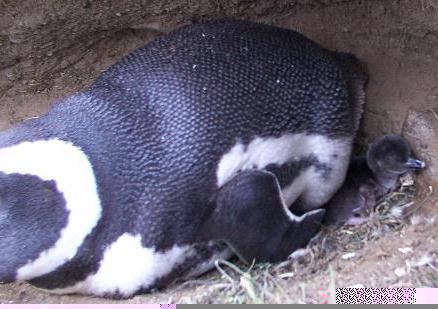 both hatched successfully. This year egg loses have been lower than usual in the
colony, thanks to the recent dry weather, and most nests having produced two
healthy little chicks.
both hatched successfully. This year egg loses have been lower than usual in the
colony, thanks to the recent dry weather, and most nests having produced two
healthy little chicks.
The newly hatched chicks weigh about 100 grams each, but they will put on weight very quickly, increasing their weight 30 times over the next 8 to 10 weeks. That is like human babies growing into 90kg men in two months! Pity the mother that has to feed them.
At the moment the chicks are small and defenceless, and need one of the parents to keep them warm and safe. The chicks' food requirements are also low at the moment, because they do not eat much being so small. So for now one of the parents always stays with the chicks, keeping them warm and safe, whilst the other parent is out at sea catching food to bring back each day.
Because the chicks are so small at the moment, and hiding under the parent, it is not yet possible for us to take photos of your chicks. However I attach a couple of photos of other newly hatched chicks, so that you can see what your chicks look like at this stage. About half way through their development, in about another 5 weeks, the chicks will be big enough for us to take photos of your actual chicks.
As the chicks grow, they soon develop the ability to keep themselves warm, and as they get bigger their demand for food also increases. Eventually their demand for food becomes greater than what one parent can catch, so both parents then leave the nest each day to catch food, leaving the chicks alone in the nest.
The chicks also become more adventurous by now, and
begin leaving the nest for short periods, making it easy for us to get good
photos. They rarely stray far though, because skuas (large gulls) are always on
the look out for careless chicks that stray too far from the safety of their
nest.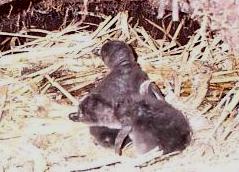
The chicks are fed almost entirely small fish of the species 'Sprattus fuegensis'.
These are not unlike what you find in cans of sardines (but without the tomato sauce). Generally the adults catch their food as close as possible to the nest, so that the chicks are not left for so long without food. For this reason good food availability close to the colony is very important during chick-rearing.
Both Chile and Argentina protect their penguin colonies from commercial fishing, but sadly the Falkland Islands refuse to do so, and this is reflected in poor chick survival around the Falklands.
Fish is very nutritious, and easily digested, which is necessary to maintain the chicks rapid growth. Adult penguins often eat other foods, such as squid and crustaceans (shrimps and the like), but the chicks need fish. Magellanic penguin chicks cannot survive on crustaceans because they are too indigestible.
It would be like trying to feed a human baby on raw crabs and lobsters.
I will write to you again with the next update in about 5 to 6 weeks, with a photo of your chicks.
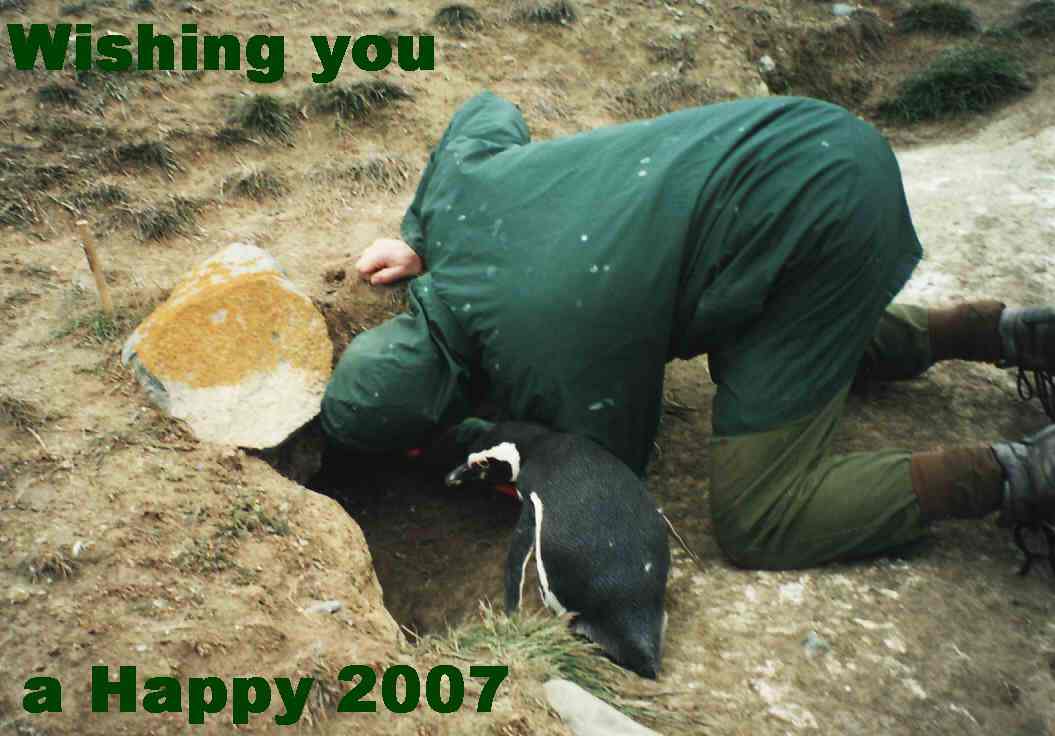
12-31-06
1-7-07
This has been a fantastic season for our penguins so
far. First of all egg losses were low, thanks to good weather during the
egg-incubation phase, and now chick survival has been very high, with very few
chicks being lost so far.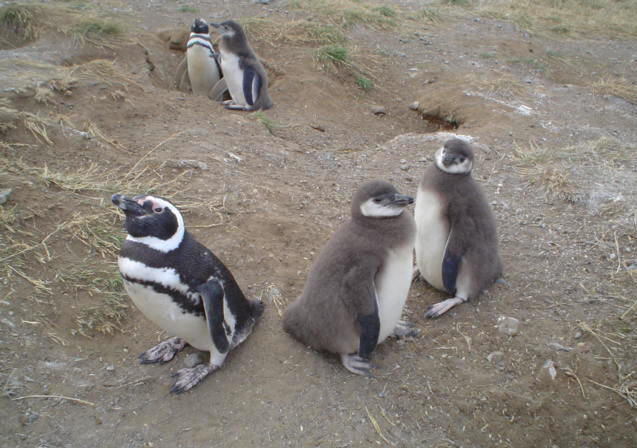
The first 10 days after hatching are the most dangerous time for the chicks, when they are still small and weak, but PoPoMo Jr's chicks are now well past that, and are now almost as big as PoPoMo Jr. Food has been very abundant this year, and the chicks have grown at an incredible rate.
The chicks are now able to leave the nest for short periods of time, and during nice weather they are wandering around near to the nest. But they do not go far, in case that predators like skuas (large gulls) are around. At the first sign of danger the chicks run back into the nest for protection. I attach a photo of PoPoMo Jr's chicks
When the chicks are less than 10 days old they can die from a number of causes.
Simply being stood on by the adult, or being left for too long uncovered, is all that it takes. But the chicks grow rapidly, and after about 7 to 10 days they are much tougher and more resistant to being squashed, and much more able to push their way back under one of the adults if they start to feel cold. From then on, provided they keep a careful eye out for predators, it is the amount of food available that effects their chances of survival, and how quickly they grow.
Some penguins, like King and Emperor penguins, only lay one egg, because these chicks are very large, and the adults would be unable to find enough food to raise two healthy chicks of such a size. Magellanic penguins lay two eggs, but the eggs hatch about 4 days apart, so one chick is slightly older, and therefore slightly bigger and stronger, than the other. If there is only enough food for one chick, then the oldest and largest chick will push its way to the front to get all the food. The younger and smaller chick only gets fed when the oldest chick is satisfied and too full to move, and so the difference in size and strength between the two chicks increases week by week when food is not abundant.
However in Chile and Argentina the penguin colonies are protected from commercial fishing, and fish are abundant, so there is plenty of food for both chicks. With both chicks getting well fed, and growing rapidly, a four day age difference disappears after a few weeks, and both chicks become equal in size, as you can see from the photo.
This is a very busy time for PoPoMo Jr, rushing backwards and forwards to the ocean to catch fish for the chicks. Adult penguins loose weight during this period, and after the chicks have left, the parents need time to rest and recover their weight and condition.
But for the chicks this is the easiest part of their life. They just hang around the nest waiting for the adults to bring them food. Their feathers are fluffy, which are good for keeping them warm when they are dry, but the chicks cannot enter the sea with these feathers. The chicks have about another 4 weeks of this pampering before they are in for a shock.
Once the chicks are fully grown, they change their fluffy chick feathers for sleek, waterproof feathers that they need for keeping them warm and dry in the ocean. And then the adults stop feeding them. When the chicks get hungry enough, and realise that the parents are not going to give them more food, they are forced to go to sea and catch food for themselves. From then on they are completely on their own.
But for now at least, the chicks have a few more weeks of being treated like royalty. I will write to you again when the chicks have left the nest to begin life on their own.
March 4, 2007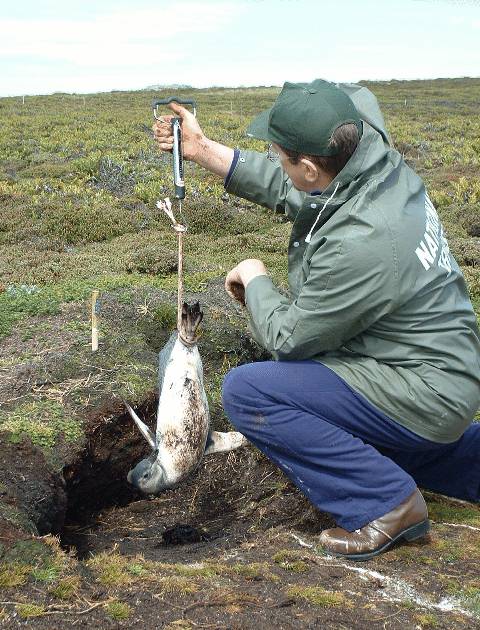
After just a few short weeks of childhood, PoPoMo Jr's
chicks have now finally left the colony to begin life on their own. For the last
few weeks their entire world has consisted of the area surrounding their nest,
and now they have the freedom of the open ocean, but it is a freedom that comes
with a price.
In the nest they were brought all their food by attentive parents, but now the
chicks are completely on their own. They must learn where to find the fish they
need for survival, and how to catch it. Their flippers have not yet reached full
strength, so they lack the speed of the adults, and yet they will not enjoy
their next meal until they have mastered the art of finding and catching fish.
Being well fed is important in keeping the chicks going until they catch their
first fish, so the chicks are weighed before they leave. I attach a photo of me
weighing a chick, to show how this is done. It looks undignified, but it does
not harm the chicks. Both of PoPoMo Jr's chicks weighed over 3 kilograms when
they left, which is good.
For the first few weeks they will hang around the best feeding areas with the
adult penguins, practising and practising, until their hunting skills improve
and their flippers gain strength. They may even pass their parents by chance,
but would no longer know them. Chicks identify their parents by calls on land,
but these calls are not used at sea.
Whilst the chicks are learning their skills, PoPoMo Jr and the other adults are
also out feeding. Chick-rearing is exhausting work for the parents, and most
adults loose weight during this period. Now the parents enjoy time to relax and
to catch all the fish they can eat, so as to regain the weight that they have
lost. Within another 4 weeks the adults will return to change their feathers
(called moulting or molting), and they need to build up good body fat reserves
before their moult.
We are rapidly approaching our Autumn (Fall) here in the southern hemisphere,
and as the hours of daylight diminish day by day, the chicks will start moving
northwards, where the hours of daylight are longer. The extra hours of daylight
afforded by moving northwards in winter means more hours during which the chicks
can hunt for food, and this is very important when they rely on seeing their
prey at depths of 30 or 40 metres below the surface, where light levels are
greatly reduced.
Next summer the chicks will migrate further south again, but probably not as far
as their birthplace. Most will not return to the colony again until they are 4
or 5 years old, by which time they will begin looking to raise chicks of their
own.
Many people have written asking to adopt the chicks. I really wish we could
allow people to adopt the chicks, but it is just impossible. With the chicks
leaving the colony and not returning for several years, it is impossible for us
to keep track of the chicks, and therefore impossible to report on their
progress. Even when they do return, we have no way of determining their
identity. Tagging (banding) penguin chicks would seriously reduce their chances
of survival, and they have enough to cope with at this time in their lives.
The average adult Magellanic penguin is so streamlined that it produces about
the same resistance through the water as a large coin. So adding an
identification tag would seriously increase the drag through the water, reducing
speed and requiring the penguin to use more energy. Tagging adults, which are
experienced at catching fish, would cause some reduction in their ability to
catch food. Tagging chicks, which face the toughest few weeks of their life when
they leave the nest, would seriously reduce their chances of survival. Such
interference could not be justified, except under special circumstances, and as
such we never tag chicks.
The adults now spend little time in the nest, and are generally either out in
the water feeding, or resting on the beach. In a few weeks they will return to
their nest to begin moulting, and I will write to let you know when that
happens.
April 29, 2007
PoPoMo Jr and our adopted penguins are now back in the
colony undergoing their annual moult. This process takes about 3 to 4 weeks, as
new feathers grow in from underneath the skin, pushing out the old feathers. The
process works in a similar way to children's first set of teeth being replaced
by adult teeth, but without the pain I hope. Having feathers in good condition
is very important for PoPoMo Jr's survival.
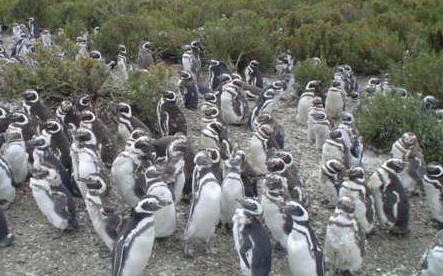
The ocean is cold, and if it were not for the incredible insulation provided by the feathers, penguins would quickly suffer from hypothermia (getting very cold). The feathers lock together with thousands of tiny hooks, which enable them to zip together, forming a tight waterproof seal. The feathers are also coated with a waxy substance, which penguins apply every time they preen themselves, which prevents water from penetrating the feathers. Water doesn't just run off a duck's back, it runs off a penguin's back too.
But just as our clothes wear out if we wear them every day, so too do PoPoMo Jr's feathers. As the feathers become damaged, they become less and less able to zip together, and if the feathers are not replaced, they would begin to leak. However the process of changing the feathers also causes major leaks in the penguin's plumage, as old feathers drop out and new ones grow in. In fact moulting causes so many leaks in the penguin's plumage that penguins are not able to enter the water at all during their moult. And since penguins find all their food at sea, that means they are unable to eat anything during their moult either.
So the penguins must stand about in the colony, unable to eat for almost a month, whilst their bodies use up large amounts of protein manufacturing a complete new set of feathers. It is for this reason that penguins need to build up their fat and protein reserves before their moult, in order to ensure that they do not starve to death before it is completed. Having said that, you do not need to worry that PoPoMo Jr might not make it. It is very very rare for penguins to starve during their annual moult. In fact the only place in the world where it is known to happen is the Falkland Islands, where the government refuses to protect penguins from commercial fishing (see
www.falklands.net).Actually the 25th Anniversary of the Falklands War is now taking place, and the Falklands' continued refusal to protect penguins from starvation caused by over-fishing, is once again attracting the attention of the international media. The Falkland Islands (a British Overseas Territory), is the wealthiest community in the whole of South America, and yet they are the ONLY country in South America that refuses to protect penguins from commercial fishing. So far 5 million penguins have been lost in the Falklands, as a direct result of commercial fishing, providing the tiny population of 2000 British citizens with a life of excess wealth and luxury.
The situation is an embarrassment that Britain should resolve without further delay.
When PoPoMo Jr and our adopted penguins finish their moult, they will then leave the colony and begin migrating northwards, to escape the southern winter. I will let you know when that happens.
June 21, 2007
PoPoMo Jr and our adopted penguins have now finished
their annual moult (molt) and have left the colony for the winter to begin their
seasonal migration up the Atlantic coast of South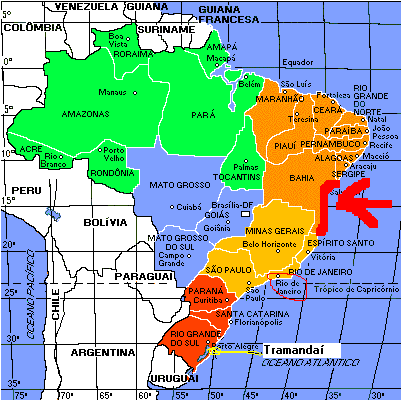 America.
We study penguins at three locations, Chile, Argentina and the Falklands, and now our penguins from all three countries merge together as they migrate northwards in search of longer hours of daylight. Catching fish at 15 or 20 metres below the sea surface means that sunlight levels need to be good. Even on a nice sunny day, light levels reduce quickly when one begins to dive down into the depths of the ocean, and penguins need to be able to see the fish to catch them.
In both the north and south poles, there is 24 hour daylight in summer, and 24 hour darkness in winter. At the equator, such as in Hawaii where I used to study sea turtles many years ago, there is very little difference in day length between winter and summer. And when you live anywhere between the equator and the pole, as most of us do, the hours of daylight we enjoy depend on which of the two we live nearest to.
Our penguin colonies in Chile, Argentina and the Falklands, are much nearer to the South Pole then the equator, so in summer the penguins enjoy long hours of daylight to feed their chicks (about 18 hours per day). But in winter these colonies have very short days (about 8 hours per day). So the penguins migrate northwards in winter to be nearer the equator, so that they can enjoy longer hours of daylight to catch fish. They very rarely reach the equator, but they do reach Brazil, with some penguins travelling several hundred kilometres north of Rio de Janeiro, which is only a few hundred kilometres short of the equator (see attached map).
Penguins are long distance travellers, as you can see, but last winter we had a confirmed sighting of a Magellanic penguin reaching England!. It was seen by several people over a period of several days in a place called Chapel Rock, which is near to Land's End in Cornwall, England. To my knowledge, this is the only reported sighting of a wild penguin in Britain, but I am always happy to receive information of similar incredible journeys.
Penguins do travel long distances, and do on occasions get lost. In our penguin colony at Magdalena Island in Chile (
www.seabirds.org/penguinstudysites.htm) we have one Little (Blue) Penguin (www.penguins.cl/little-penguins.htm), that has been living on the island for the last 5 years. These penguins live in Australia and New Zealand, which as you will see from any world atlas, is a very long way from South America.What is interesting is that in some areas of Australia and New Zealand, Little penguins have become so used to people that they nest under houses. And we first found our Little penguin not in a burrow, or with the Magellanic penguins, but under our generator shed.
Little penguins do not migrate like Magellanic penguins, so in winter our Little penguin is the only penguin still around on Magdalena Island. In winter it now uses one of the burrows down by the water's edge, but in summer, the larger owner of the burrow (a Magellanic penguin) takes back the burrow, and our Little penguin is left homeless for a few months.
Also on Saunders Island, in the Falklands, there are two Chinstrap penguins (
www.penguins.cl/chinstrap-penguins.htm) that have been living amongst the Gentoo penguins for years. These penguins come from Antarctica and sub-Antarctic islands. Quite why some penguins should travel so far, only to become lost, is unclear. However it can sometimes result in the establishment of penguin colonies in new places. On Martillo Island (near Ushuaia) and Staten Island, both in Argentina, new Gentoo penguin colonies have become established within the last 15 years. These are the first Gentoo penguin colonies recorded on the South American continent. Now if only the penguin sighted in England could just find a partner!Even though our adopted penguins migrate northwards every winter, it is not like the migration of flying birds. Magellanic penguins do not set off on one long journey. Instead they simply hunt for food each day in a northerly direction, instead of in circles, so that day by day they gradually move northwards.
Then around July, they change, and begin hunting for fish in a southerly direction, so that they eventually arrive back at their colony. It will be September before our penguins arrive back home, but I will write to you again in a few weeks with results from this season's studies.
August 15, 2007
PoPoMo Jr and our adopted penguins have now reached the farthest point of their winter migration. In another couple of weeks they will begin making their way back down the Atlantic coast of South America, back to their nests, ready to begin another season of egg-laying and chick-rearing. So this seems a good time for me to tell you about the results of our penguin research which your adoption pays for.
As you will know from previous reports, Magellanic penguins only live in Chile, Argentina and the Falkland Islands, and we have study colonies in all three locations.
Last season was a really good year for most of our penguins, with lots of healthy chicks being reared in Chile and Argentina. Our study sites in these two countries showed very similar results, with both sites averaging about 1.4 chicks per nest, one of the best years we have ever recorded. Two eggs are laid in each nest, so this means that about 70% of all eggs laid grew into healthy chicks that survived to begin life on their own. This is very good indeed. About one chick per nest (or 50% of eggs laid) is more than enough to maintain a healthy population.
I attach three graphs showing the results from each of our study sites. The left side of each graph shows how the colony starts with 100% of the eggs laid still surviving (because they have only just been laid), and as time goes by this gradually gets less as eggs and chicks are lost one by one. The line along the bottom gives the date, and above the date you will see the words 'Eggs', 'Chicks' and 'Fledged' which show the stage of development for that date. (Fledged means the chick is fully grown and has left the nest to begin life on its own). Please remember that these dates and stages of development are averages for the whole colony, so they may be different from your penguin.
You will see that the graphs for Chile and Argentina are very similar. The main losses at both these sites were losses of eggs and small chicks, and this indicates a healthy colony. Some eggs are always lost before they hatch. Some are infertile, some are stolen by predators, and some get abandoned or broken by inexperienced parents. Bad weather and food shortages can increase egg losses, but last season egg losses were normal.
Very small chicks also die for a number of reasons during the first 7 to 10 days of their life, because they are so weak and helpless at this age. Being so small they can easily get stood on by the adults, or fall out of the central nest area and get cold, or simply loose too much strength struggling to break out of the egg. These are natural causes, and have nothing to do with the health of the colony or the availability of food. The reason that this 7 to 10 day period covers about a month on the graph is because the chicks are not all hatching on the same date.
After chicks reach about 10 days of age they are strong enough to survive minor mishaps, and their survival from then on depends almost entirely on the availability of food. If food is plentiful, chick losses will be very low, and this is what we see for both Chile and Argentina. At these two sites very few chicks died after they had reached 10 days of age (the graph is flat showing very little reduction in the number of eggs surviving) which indicates a healthy colony with good food supply. This is largely thanks to the control of commercial fishing around penguin colonies by the Chilean and Argentine governments.
Unfortunately the situation is very different in the Falkland Islands, as you can see from the graph, because in the Falklands the penguins are not protected from commercial fishing. Right from the start egg losses and losses of small chicks are much greater than in Chile and Argentina. Fish and squid are in such short supply around the Falklands, because of commercial fishing, that adult penguins are forced to travel such long distances looking for food that many penguins abandon their nests. Also you can see from the graph that even after chicks have reached 10 days of age, the chicks continue to die, (the graph keeps dropping), and this is the result of starvation.
Around the Falklands there are so many fishing boats removing the fish and squid which penguins need to feed their chicks, that most chicks do not get enough to eat, and eventually starve or become so weak that they die from illness. This situation has been carrying on for the last 20 years, and penguin populations have declined by over 90% in the Falklands as a result. Many of our adoptees will know of my long-standing battle with the Falklands government over protection for penguins (see www.falklands.net), but help might be at hand at long last, and you can help too.
The U.S. Fish and Wildlife Service have announced that they are considering adding 10 penguin species to the Endangered Species Act, including two species that breed in the Falkland Islands. The Magellanic penguins are not included amongst these ten, because their populations are still healthy in Chile and Argentina, but they will nevertheless benefit from commercial-fishing restrictions that the Falkland Islands may eventually be forced to impose if the proposals go ahead.
Even though no penguins breed in the USA, the protection of these penguins under the Endangered Species Act would be of great benefit to conservation efforts wherever these penguins live.
The US Fish and Wildlife Service have opened up a consultation period, during which they invite comments and opinions from all interested parties as to whether these penguins should be included in the Endangered Species Act or not.
People have until the first week of September to send in their views, and I invite as many people as possible to write in supporting the inclusion of these penguins in the Endangered Species Act.
You can send your views by letter to The Special
Assistant to the Deputy Assistant Director International Affairs U.S. Fish and
Wildlife Service
4401 N. Fairfax Drive, Room 760
Arlington, VA 22203 - USA
OR by fax to 703-358-2276 OR by Email to DSApenguins@fws.govOR through the Federal eRulemaking portal at www.regulations.gov.
Below you will find the full details of the new proposals, and I also attachour letter of support for these proposals.
Best wishes,
Mike
October 8, 2007 - FINAL TRANSMISSION
Our penguins are now back in the colony to begin
another season of egg-laying and chick-rearing, so you will soon be receiving
photos of PoPoMo Jr. Males arrive back a few days before the females, and wait
for their partners to return.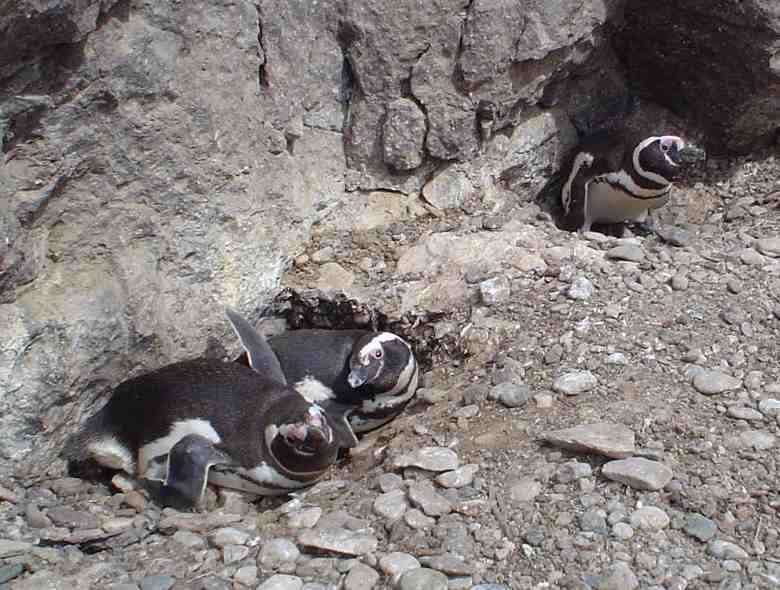
There are always more males than females, so males cannot risk loosing their partner to another male by arriving home late.
As the pairs meet up again after several weeks apart, they renew their friendship by rituals of head-bowing and synchronised calls. Magellanic penguins raise their heads skywards, and let out a long bellowing sound that is almost identical to a donkey braying. This strange call has earned this family of penguins the nickname 'Jackass penguins".
Once the friendships and marriage vows have been re-established, the penguins begin the task of rebuilding their nests. Pairs return to the same nest each year, but the harsh winter weather causes serious damage to the nests, so they need to be repaired before egg-laying can begin. The winds in southern Patagonia, where our penguins live, are so strong that in dry weather so much dust is blown around that burrows can become buried, and can disappear completely within a few days when the penguins are not around to keep up the maintenance. In wet weather, so much rain can fall that entire areas of the colony can become submerged (see attached photo). Fortunately this mostly happens in winter when the penguins are away from the colony.
In our Chilean and Falklands colonies, the penguins make their nests inside burrows, but these burrows often collapse during the winter, and need re-digging, which takes many days. Digging is done with the feet, which have long powerful claws. The usual method of digging is to lie on their backs and scratch rapidly at the soil. Some digging is also done with the beak. Burrows provide good protection from predators, such as skuas (large gulls), so Magellanic penguins always dig burrows when possible. But in our Argentine colony at Cabo Virgenes, the soil is very sandy, making it impossible to dig burrows because the soil simply collapses. (Try digging a tunnel on a sandy beach).
So at Cabo Virgenes, and at most of the other colonies in Argentina, Magellanic penguins do not dig burrows. Instead they nest in an area covered in thorny bushes, and dig simple depressions at the base of the bushes, using the bushes to give shelter from the weather and predators. Although this gives less protection from predators and bad weather, it does have some advantages. During exceptionally severe summer rains, burrows can fill with water, but the simple depressions made in sandy soil do not. Secondly, until chicks reach about 4 or 5 weeks of age, they are forced to go to the bathroom inside the nest, so burrows become exceedingly smelly and unhealthy. One definite advantage of an open nest.
To show just how adaptable Magellanic penguins are, I attach a photo I took on Isla Pinguino in Argentina. Here there is no soil and no vegetation, so the penguins nest in open nests amongst the stones. In a couple of weeks time I will be sending out the photos of all our adopted penguins in Argentina. Then about two weeks after that, our penguins in Chile. The timing of sending out photos is determined by the penguins and not by us
We have to wait until the penguins have laid their eggs before we can take the photos. If we attempted to take photos earlier we would risk causing the penguin to flee the nest. Our penguins in Argentina are now almost at the point of egg-laying, so I estimate a couple of weeks to send out these photos. The penguins in Chile are always a couple of weeks behind those in Argentina, so it will be early November when these photos go out. Our penguins in the Falklands are always the last to lay, a couple of weeks behind Chile.
You can see a map showing the locations of our three study sites at www.seabirds.org\penguinstudysites.htm and you can find photos, maps and information about each site at www.seabirds.org\study-argentina.htm / www.seabirds.org\study-chile.htm,www.falklands.net
Best wishes - Mike